
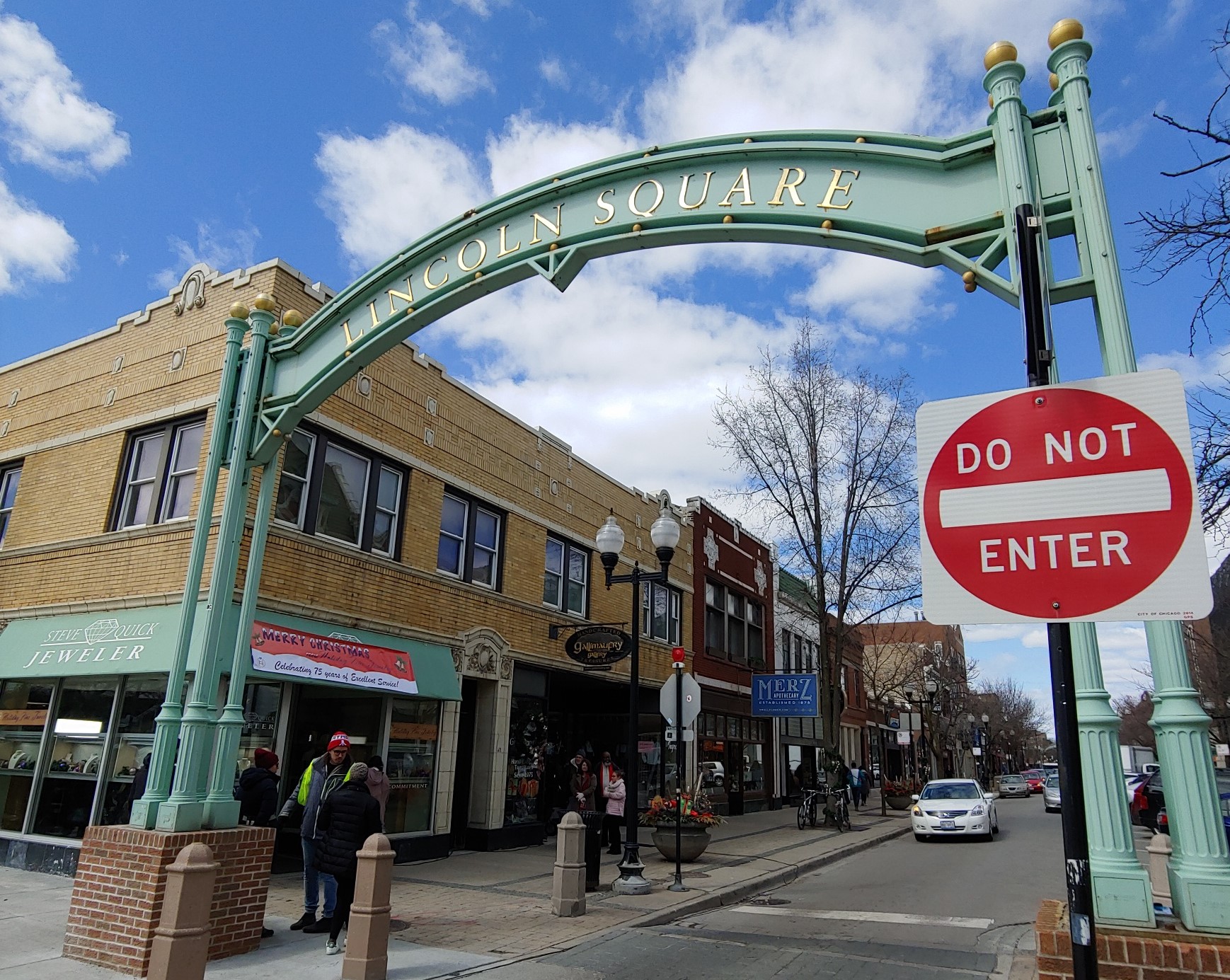
GETTING TO KNOW LINCOLN SQUARE
What’s the Appeal? Although Lincoln Square has long offered an excellent mix of housing options, public transit access and spacious parks, it has been the revitalization over the last 40 years of its commercial corridor along Lincoln Avenue between Montrose and Lawrence that made the area the popular shopping, dining and entertainment destination it is today. The Lincoln Square Mall, established in 1978, kicked off the process, while the arrival of the Old Town School of Folk Music and the renovation of the Davis Theater helped push it to new heights.
Where Is It? The name Lincoln Square refers to both the commercial district centered around the intersection of Lincoln, Western and Lawrence avenues and the larger community area that surrounds it, which includes the neighborhoods of Bowmanville, Budlong Woods, Ravenswood and Ravenswood Gardens. The Lincoln Square community starts at Montrose Avenue on the south and is bounded on the west by the North Branch of the Chicago River and on the east by the Union Pacific/Metra railroad tracks along Ravenswood Avenue. The northern border wraps around Rosehill Cemetery, running along Bryn Mawr Avenue west of Western, then jogging north and following Peterson Avenue east to Ravenswood.
What’s in the Name? Much of the area was first known as Ravenswood, the name given to the suburban residential development established along the railroad tracks in 1868. The Lincoln Square designation came into wide use only after World War I when merchants around the Lincoln/Western/Lawrence intersection wanted to build a stronger identity for their retail community and convinced the Chicago City Council to name the intersection Lincoln Square. Eventually, the local chamber of commerce commissioned the statue of President Abraham Lincoln that marks that intersection today. The statue of a young, beardless Lincoln was designed by Lloyd Ostendorf for a contest sponsored by the City of Chicago and created by sculptor Avard Fairbanks. It was dedicated on October 16, 1956.
Who Were the Earliest Residents? Originally located well north of Chicago’s city limits, the Lincoln Square area was used primarily as farmland and for suburban housing. It’s first important settler, Swiss immigrant Conrad Sulzer, arrived in 1836, and his family remained a force in the community well into the 20th Century. The Sulzer Regional Library on Lincoln Ave. commemorates their contributions. Most of the agriculture in the area consisted of truck farms specializing in celery and cucumbers, the latter being essential to the plans of the Budlong Brothers, who established a successful pickle factory in 1857 and later moved into the flower business, growing flowers in both field and greenhouses. Today’s Budlong Woods neighborhood occupied the land that was once theirs. However, majority of the other early farmers were German immigrants, and even today that German heritage is a vital part of Lincoln Square’s character.
Claims to Fame? These days, Lincoln Square’s biggest attraction is probably its diverse array of excellent restaurants, headed by three Michelin one-star eateries: Goosefoot, Elizabeth and Band of Bohemia. Less trendy but probably more enduring is Rosehill Cemetery, established in 1859, which at 350 acres, is Chicago’s largest cemetery and the resting place of more than 300 Civil War soldiers as well as many prominent Chicagoans, including an array of Chicago mayors, Illinois governors and Charles G. Dawes, 30th vice president of the United States. The name Rosehill is a clerical error. It was supposed to be named Roe’s Hill, after farmer Hiram Roe, who owned the land and sold it only after being assured the cemetery would be named for him. Other famous people buried at Rosehill include retailing giants Richard Sears, Julius Rosenberg, Aaron Montgomery Ward and John W. Shedd, suffragist and temperance leader Frances Willard, advertising legend Leo Burnett, Hall of Fame broadcaster Jack Brickhouse, bicycle maker Ignaz Schwinn, Burr Tillstrom, who created of Kukla, Fran and Ollie, and architects George W. Maher, famous for his Prairie-style homes, and William Boyington, designer of both Chicago’s Water Tower and the Rosehill Cemetery gate. Another small gem sparkles at 4611 N. Lincoln Avenue. It is the Krause Music Store, a National Historic Landmark and the last completed work of Louis Sullivan, one America’s greatest architects.
AWARD WINNING SERVICES

GLOBAL REACH & HOME INSURANCE



WEBSITE AWARDS



Market Report
Sign up today to stay updated on what’s happening in your local real estate market.
